

At the Headache, Neck, and Jaw Clinic, we understand that jaw pain, persistent headaches, and neck problems can share a common source. Rather than treating individual symptoms, addressing the source is usually the best way to produce lasting results
When it comes to patients dealing with temporomandibular joint (TMJ) dysfunction and its associated symptoms, Rocabado’s 6×6 Programme is one of the most effective tools we use. If you’ve had jaw clicking, trouble opening your mouth, facial pain, or headaches that no one has been able to properly explain, we’ll help you understand what Rocabado’s method is and why it may offer the relief you’ve been looking for.
What Is Rocabado’s Approach and How Does It Work?
Mariano Rocabado is a Chilean physiotherapist whose work has changed how doctors think about and treat jaw problems. Rocabado identified something that was largely overlooked at the time: the jaw does not function in isolation. Its position, movement, and health are directly influenced by the posture of the head and the mechanics of the upper cervical spine.
He called this interconnected system the craniocervical-mandibular complex, which is, ironically, a bit of a mouthful. In simple terms, it means how the skull, neck, and jaw are connected, and his main idea was that issues in one section of this system cause difficulties in the others:
- If your jaw doesn’t rest in the right place, it puts more tension on your neck.
- When the head is too far forward, the jaw opens and closes differently.
Treating the jaw without addressing the neck, or the neck without considering the jaw, often produces incomplete or temporary results. Rocabado’s treatment approach has two core elements.
The 6×6 Exercise Program
The 6×6 is a group of workouts that you do six times a day. These exercises are designed to retrain the jaw, rather than just stretch or strengthen. The jaw can develop bad habits over time, just like any other joint that doesn’t work right. Short, regular repeats throughout the day slowly change those patterns and create new ways to rest. One workout a day won’t do this, but regular activity throughout the day will.
The Postural Component
Rocabado was particularly interested in how forward head posture affects jaw mechanics. When the jaw is in this posture, it is dragged back and down from its optimal alignment, which puts a lot of stress on the TMJ and the muscles around it. That means that fixing the way you hold your head and neck is part of healing the jaw.
The Rocabado Exercises at a Glance
Keep in mind this is for general understanding only, and you shouldn’t try this yourself before speaking to our team. At your appointment, your physiotherapist will assess, demonstrate, and tailor all six exercises to your specific needs during your appointment.
| Exercise | What It Does |
| Tongue resting position | Trains the tongue to rest on the roof of the mouth, which supports correct jaw posture and reduces muscle tension |
| Controlled jaw opening | Retrains the jaw to open in a straight, controlled path rather than deviating to one side |
| Rhythmic jaw stabilisation | Gentle resistance exercises that improve the coordination of the muscles that control jaw movement |
| Axial extension of the cervical spine | A posture correction exercise that gently draws the head back over the shoulders, reducing forward head posture |
| Shoulder girdle retraction | Opens the chest and draws the shoulders back, supporting correct head and neck alignment |
| Diaphragmatic breathing | Trains proper breathing mechanics, which reduces the use of accessory neck muscles and decreases tension in the jaw and neck region |
What to Expect During Treatment
Rocabado’s approach may feel different from other physiotherapy you’ve experienced, so it’s worth knowing what to expect before your first appointment.
Your physiotherapist will begin with a thorough assessment that looks at both your jaw and your neck together. They’ll assess your jaw’s range of movement, resting position, and any clicking or deviation during opening. They’ll also look at your head and neck posture and how the two relate to your symptoms.
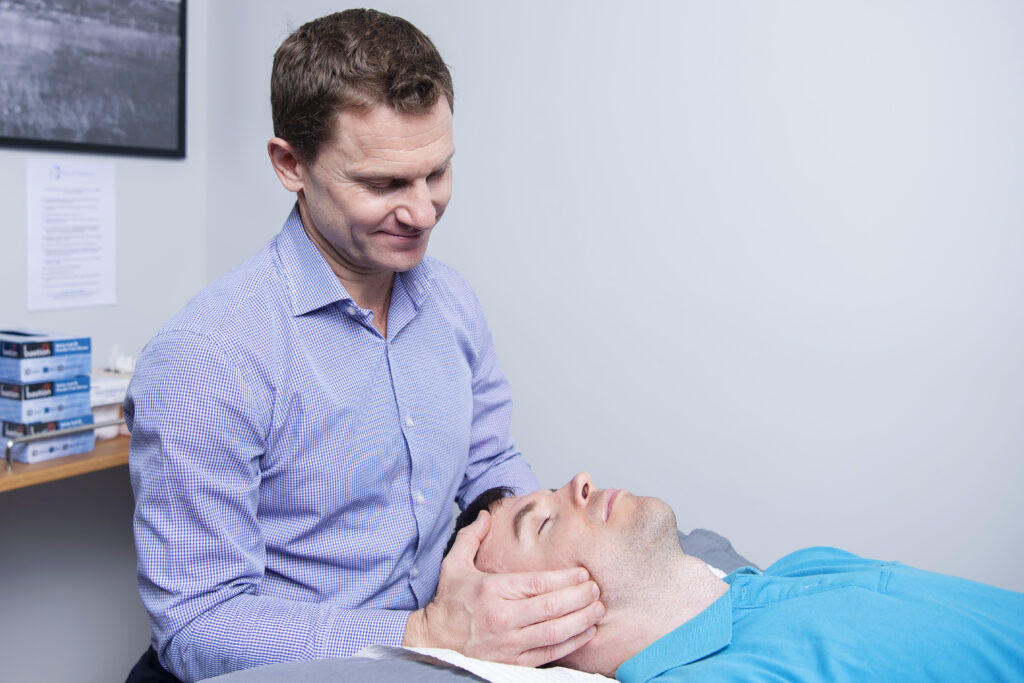
Treatment sessions involve both hands-on work and education. Your physiotherapist may use manual techniques to address restrictions in the jaw or cervical spine alongside teaching you the 6×6 exercises. A big part of your appointment will be making sure you know how to complete each exercise correctly and feel comfortable performing it at home.
What you do between sessions will have a big impact on your results. Patients that stick with the 6×6 consistently tend to have much better results than those who don’t. With Rocabado’s method, progress is usually slower than with strategies like Mulligan, where you can feel results right away. Expect improvements to happen over weeks instead of days. However, many patients do notice changes in how comfortable their jaw is and how they rest it early on in the treatment.
How Rocabado’s Approach Helps Jaw Pain and TMJ Dysfunction
The temporomandibular joint is one of the most complex and heavily used joints in the body. It moves hundreds of times a day when you talk, chew, swallow, or yawn, so even small problems can cause chronic, unavoidable pain.
Rocabado identified that one of the key drivers of TMJ dysfunction is the jaw’s resting position. In a correctly functioning jaw, there is a small, relaxed space between the upper and lower teeth when the mouth is closed. Many patients with TMJ dysfunction have lost this resting position. Their jaw muscles are always working, and the joint is always under a low-level load.
The 6×6 program addresses this directly. The controlled jaw opening exercise retrains the way the jaw moves, which cuts down on the uneven loading that causes clicking and wear on the joints. The rhythmic stabilisation exercise helps the muscles work together better so that the jaw operates as a balanced, coordinated system instead of compensating for pain or constraint.
Benefits of Rocabado’s 6×6
- Treats the jaw-neck-head system together: Rather than addressing TMJ dysfunction in isolation, Rocabado’s approach looks at how the head, neck, and jaw are connected.
- Structured and easy to follow: The 6×6 gives you a clear, specific daily routine. There’s no ambiguity about what to do or how often to do it.
- Strong self-management component: Once you’ve learned the exercises, you can manage your condition independently, reducing the need for ongoing clinic visits over time.
- Gentle and progressive: The exercises are designed to be comfortable and accessible, making this approach suitable for patients who find hands-on treatment difficult or have been in pain for a long time.
- Particularly effective for long-standing TMJ problems: When dysfunction has persisted for months or years, the jaw has generally established entrenched movement patterns. The 6×6’s retraining approach addresses this in a way that single or infrequent treatments can’t.
- Complements our other specialist techniques: Rocabado’s programme works alongside the Watson Headache Approach, the McKenzie Method, and the Mulligan Concept. Your treatment plan at HNJ may draw on more than one of these approaches, depending on your assessment.
Need Relief From Jaw Pain, Headaches, or Neck Pain?
Like many of our patients, you might have seen multiple practitioners before coming to us. You might have tried other physiotherapy, dental treatments, or medication, only to give up when they only provide partial or temporary relief. But the problem might not be that the treatments were wrong; it might just be that nobody was looking at the full picture. When the jaw, neck, and head are evaluated together, the path to lasting improvement becomes much clearer.
Our team of specialist physiotherapists will take the time to understand your history, identify the source of your symptoms, and recommend the approach most likely to help, whether that’s Rocabado’s 6×6, or another technique.
Book an assessment with our team to take the first step toward lasting relief.


Nigel Smith, co-founder of The Headache, Neck & Jaw Clinic, has over 20 years of experience as a specialist physiotherapist in jaw, neck, and headache pain management. Initially pursuing sports physiotherapy, Nigel found his true calling in TMJ treatment following a chance encounter with an oral surgeon.
His personal experience with TMJ issues and his dedication to developing conservative treatment pathways have made him a go-to expert for Dentists and oral surgeons seeking alternatives to surgical options.
Nigel’s commitment to excellence includes advanced training with the Watson Headache® Institute and lecturing at the University of Queensland. His expertise, backed by decades of hands-on practice and training, makes him a respected leader in this niche field. You can read more about my background, here.