

When we think about ‘core strength’ most people picture abs, planks, and Pilates. But did you know your neck also has its own core muscles? These are called the deep neck flexors, and they play a crucial role in posture, pain, performance, and long-term neck health.
Let’s explore why these muscles matter, why they often weaken in modern life, and how you can strengthen them.
What Are the Deep Neck Flexors?
The deep neck flexors are a group of small but powerful muscles located at the front of your neck. The most important ones are:
- Longus colli
- Longus capitis
These muscles sit underneath the larger, more visible neck muscles. While the big muscles move your head, the deep neck flexors are responsible for stability, control, and fine-tuning movement.
Think of them as the ‘core of your neck’.
Why Do Deep Neck Flexors Weaken So Easily Today?
Modern lifestyles are one of the biggest reasons these muscles become weak and poorly coordinated.
Desk Jobs
Many people spend hours sitting at a desk, working on a computer or laptop. Over time, this leads to a forward head posture. When your head moves forward, the deep neck flexors become underused and inhibited, while the larger neck and shoulder muscles become overactive.
This imbalance means:
- The neck loses stability
- The upper trapezius and superficial neck muscles take over
- Muscle fatigue and tension build throughout the day
Because these muscles are designed for endurance and control, they need low-level, continuous activation. Sitting in poor posture switches them off.
Smartphone and Tablet Use
Looking down at your phone for long periods puts a significant load on your neck. Even small angles of forward head posture can significantly increase strain on the cervical spine.
With frequent phone use:
- The deep neck flexors become lengthened and weak
- The back of the neck becomes tight and overloaded
- The nervous system becomes more sensitive
- Jaw and headache symptoms may increase
This is sometimes called ‘tech neck’.
Over months and years, the brain loses awareness of these stabilising muscles, making it harder to activate them when needed.
Why Are Deep Neck Flexors So Important?
1. Posture Support
- Strong deep neck flexors help:
- Support your head in a neutral position
- Reduce load on the neck and shoulders
- Improve overall spinal alignment
2. Neck Pain Prevention and Recovery
People with neck pain often have weak or poorly coordinated deep neck flexors. When these muscles don’t work well, the larger neck muscles compensate, leading to:
- Tightness
- Fatigue
- Headaches
- Jaw and TMJ symptoms
- Shoulder tension
Re-training these muscles is a key part of physiotherapy for chronic neck pain.
3. Jaw and Headache Relief
There is a strong connection between the neck and the jaw. Research has shown links between deep neck flexor weakness and conditions such as:
- Temporomandibular joint disorder
- Tension headaches
- Migraines
Improving deep neck control can reduce strain in the jaw and upper nervous system.
4. Nervous System Regulation
These muscles also play a role in breathing and nervous system balance. Gentle activation can help calm the system, making it valuable for people with:
- Stress
- Anxiety
- Poor sleep
- Chronic pain
Signs Your Deep Neck Flexors May Be Weak
You may benefit from training these muscles if you notice:
- Neck stiffness or tightness
- Frequent headaches
- Jaw tension or clicking
- Poor posture
- Feeling your shoulders are ‘always working’
- Neck fatigue during the day
- Difficulty sitting upright for long periods
How to Activate the Deep Neck Flexors (Sitting Version)
This version is ideal for desk workers because it can be done at your workstation.
Deep Neck Flexor Activation – Finger Chin-to-Chest + Nod
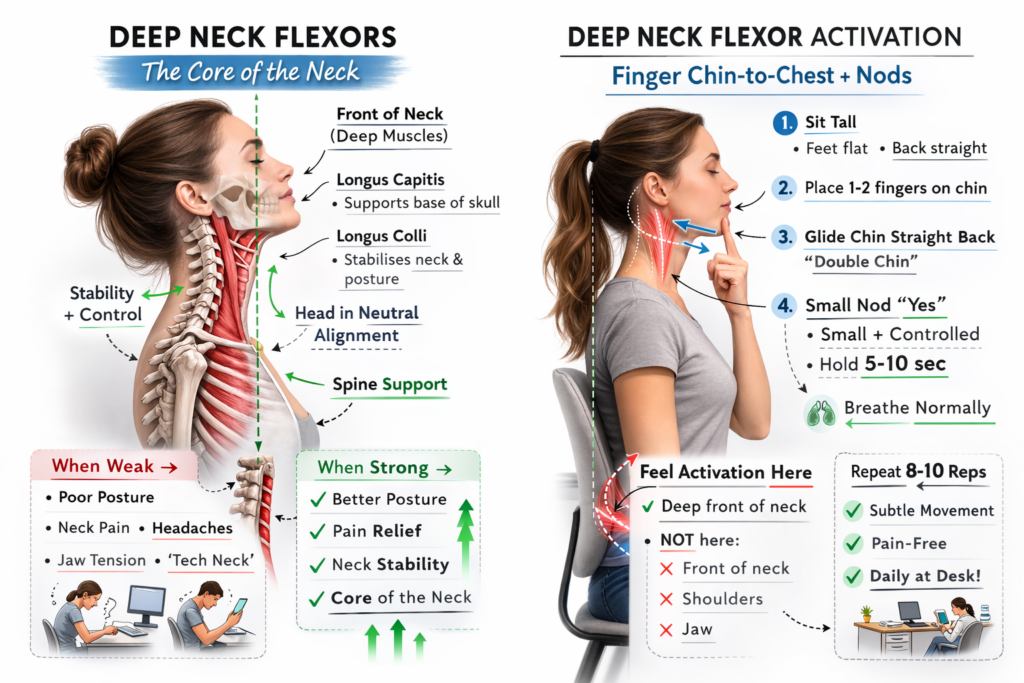
1. Sit tall with your feet flat on the floor.
2. Lengthen through the crown of your head.
3. Place one finger gently on your chin.
4. Without lifting or dropping your head, gently draw your chin straight back (as if making a ‘double chin’).
5. From that position, perform a small nod — like you are subtly saying ‘yes’.
6. Keep the movement small and controlled.
7. You should feel a gentle activation deep in the front of your neck — not gripping in the big surface muscles.
8. Hold for 5–10 seconds while breathing normally.
9. Repeat 8–10 times.
The key is subtle control, not force. If you feel strong tension in the front or sides of your neck, reset and make the movement smaller. This exercise retrains the brain to reconnect with the deep stabilising system — the true core of the neck.
Common mistakes made when trying to activate your deep neck flexors
Many people unknowingly:
- Push too hard with their finger
- Over-retract the chin
- Lift the chin instead of gliding it back
- Brace the jaw
- Hold their breath
Quality is far more important than intensity.
The Bigger Picture: Strength + Mobility + Relaxation
True neck strength is not about building bulky muscles. It is about:
✔ Stability
✔ Control
✔ Endurance
✔ Coordination
✔ Nervous system balance
A healthy neck program should include:
- Deep neck flexor training
- Posture awareness
- Thoracic mobility
- Breathing work
- Relaxation of tight muscles
- Smart screen habits and movement breaks
In Summary
In a world of desk work and smartphones, training your deep neck flexors is more important than ever. By restoring this ‘neck core’, you can reduce pain, improve posture, support your jaw, and move with more ease and confidence.
If you have ongoing neck or jaw issues, book a physiotherapy assessment with the Headache Neck and Jaw Clinic.
Our clinics specialise in the treatment of complex head, neck, and jaw conditions, and can help tailor the right program for you. Small, consistent changes can lead to powerful long-term results.

Lisa Eisfeld is a trained physiotherapist from Germany. She has also studied advanced Manual therapy and finished her Osteopathy Diploma in 2018 at the School for Manual Medicine Berlin. Lisa has also attained her Watson Headache® Approach Level 1 Foundation and Level 2 Consolidation courses. Read more about Lisa.