

If you’ve been searching for ways to manage sudden bouts of dizziness or spinning sensations, chances are you’ve come across Brandt-Daroff exercises. They’re widely recommended online as a simple, do-it-yourself approach to vertigo, and for some people, they do provide relief.
But Brandt-Daroff exercises aren’t a one-size-fits-all solution, and using them without understanding what’s actually causing your dizziness can mean wasted weeks and ongoing frustration. If you’re dealing with persistent or recurring vertigo, proper vertigo treatment starts with finding out exactly what’s going on, not guessing.
What Are Brandt-Daroff Exercises?
Brandt-Daroff exercises are a set of repetitive movements developed in the 1980s by researchers Brandt and Daroff for people experiencing vertigo caused by Benign Paroxysmal Positional Vertigo (BPPV).
The exercise itself is straightforward.
- Sit on the edge of a bed
- Quickly lie down on one side with your head turned at an angle
- Stay there until any dizziness settles
- Return to sitting
- Repeat on the other side.
This sequence is usually repeated several times, multiple times a day, often for one to two weeks.
Because they require no equipment and can be done at home, Brandt-Daroff exercises have become one of the most commonly suggested “first steps” for people experiencing vertigo.
How Do Brandt-Daroff Exercises Work?
Brandt-Daroff exercises work through a process called habituation. Rather than physically repositioning anything in your inner ear, the repeated movement is designed to provoke the dizziness response repeatedly until your brain gradually becomes less reactive to it.
It’s similar to how a ticking clock seems loud when you first notice it, but fades into the background the longer you’re in the room. Your brain hasn’t silenced the sound; it’s just decided the signal isn’t worth reacting to anymore. Brandt-Daroff exercises work on a similar principle: by repeatedly triggering the dizziness response, your brain gradually decides it doesn’t need to react so strongly to that signal.
Do Brandt-Daroff Exercises Actually Work?
Brandt-Daroff exercises can help reduce dizziness for some people with BPPV, particularly as a supportive or maintenance strategy. However, they tend to work more slowly than targeted repositioning manoeuvres, and they’re far less effective if the underlying cause of your dizziness isn’t BPPV in the first place.
BPPV itself has different variants depending on which part of the inner ear is affected, and the most effective repositioning manoeuvre depends on correctly identifying which one you have. Brandt-Daroff exercises are a more generalised approach, which is part of why they can take longer to produce results, and why some people find they don’t help much at all.
If you’ve been doing these exercises faithfully for a couple of weeks without any improvement, that’s not necessarily a sign you’re doing them wrong. It may simply be a sign that BPPV isn’t actually your underlying issue, or that a more targeted manoeuvre would get you better results faster.
Why Self-Treating Vertigo Without a Diagnosis Can Be a Problem
Vertigo and dizziness can stem from a wide range of causes, and BPPV is just one of them. Vestibular migraine, cervicogenic dizziness (originating from the neck), vestibular neuritis, Meniere’s disease, and persistent postural-perceptual dizziness (PPPD) can all produce similar sensations of spinning, unsteadiness, or imbalance.
Brandt-Daroff exercises are specifically designed for BPPV. If your dizziness is actually coming from your neck or a vestibular migraine, these exercises may do little to help, and you could spend weeks following generic advice without addressing the real problem.
This doesn’t mean Brandt-Daroff exercises are risky to try. But if symptoms persist, worsen, or keep returning, you’re better off getting a proper assessment rather than continued self-management.
How We Assess and Treat Vertigo at HNJ Clinic
At the Headache, Neck and Jaw Clinic, our physiotherapists are trained to identify exactly what’s driving your dizziness before recommending any treatment.
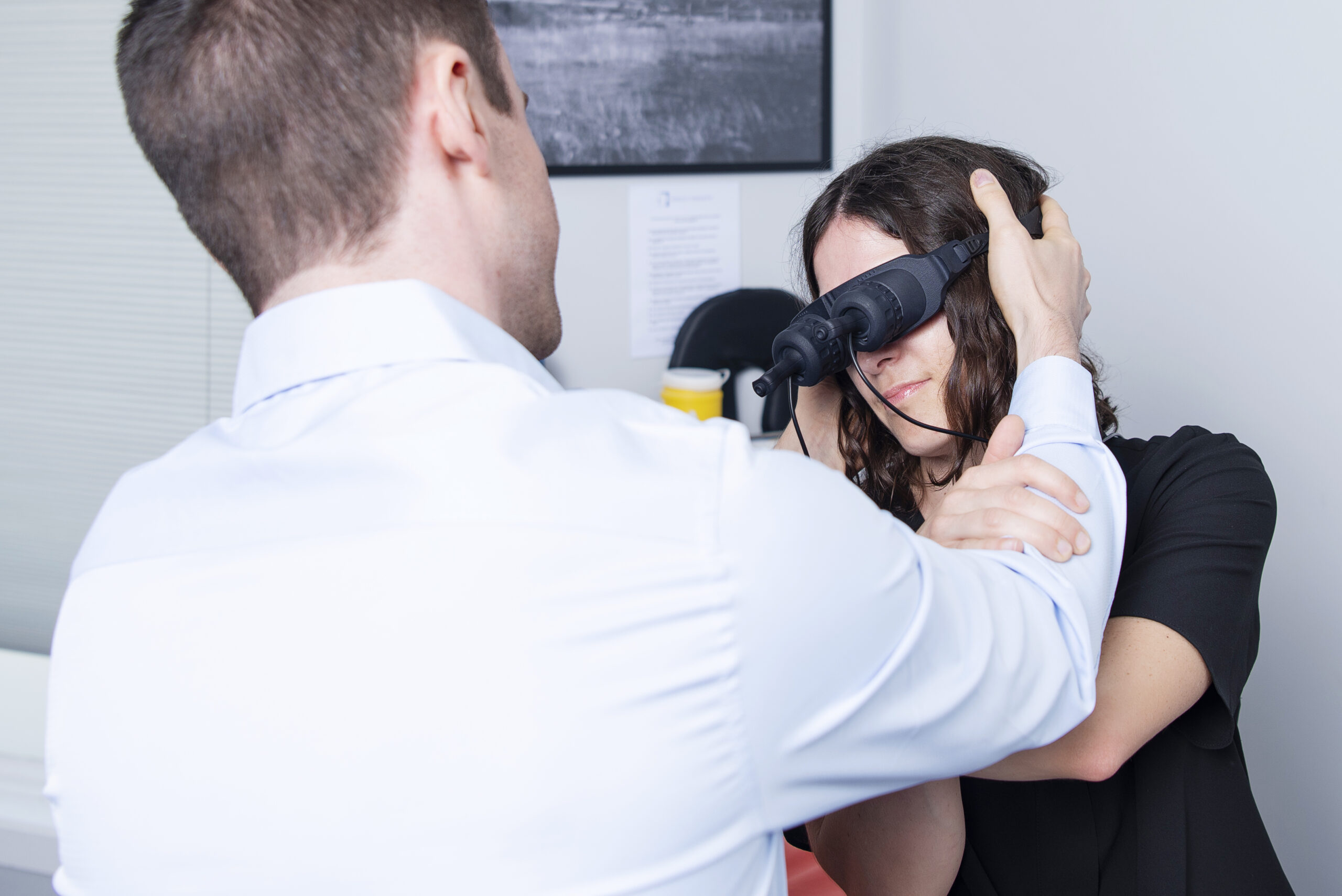
Your assessment includes a detailed discussion of your symptoms and history, along with a hands-on evaluation of your balance, coordination, and eye movements using vesticam goggles, infrared technology that helps us pinpoint whether your dizziness is coming from your inner ear or your central nervous system.
From there, we can determine whether your symptoms fit the pattern of BPPV so we can apply the correct repositioning manoeuvre rather than a generalised exercise. If your neck is contributing to your dizziness, we use manual therapy and joint mobilisation to address that directly. And if vestibular rehabilitation therapy is the right fit, we’ll build a program tailored to your specific symptoms rather than a generic handout.
Don’t Let Vertigo Control Your Life
Brandt-Daroff exercises can be a useful starting point for some people, but they’re not a substitute for an accurate diagnosis. If you’ve tried them without success, or you’re dealing with dizziness that keeps coming back, it’s time to find out what’s really going on.
Our physiotherapists can assess your symptoms, identify the underlying cause, and build a treatment plan that’s actually designed for your specific type of vertigo.
Book an assessment with our team to get to the bottom of your dizziness.
Frequently Asked Questions
How long do Brandt-Daroff exercises take to work?
If they’re going to help, most people notice some improvement within one to two weeks of consistent daily practice. If you haven’t seen any change after this time, it’s worth getting assessed to check whether BPPV is actually the cause.
Can I do Brandt-Daroff exercises if I have neck pain?
If your dizziness is linked to neck issues (cervicogenic dizziness), Brandt-Daroff exercises won’t address the underlying cause and may not be the right approach. A physiotherapy assessment can determine whether your neck is contributing to your symptoms.
Are Brandt-Daroff exercises the same as the Epley manoeuvre?
No. The Epley manoeuvre repositions displaced crystals in the inner ear back to their correct location, while Brandt-Daroff exercises work by habituation, training the brain to become less reactive to the dizziness trigger. The right approach depends on the specific cause and type of your vertigo.
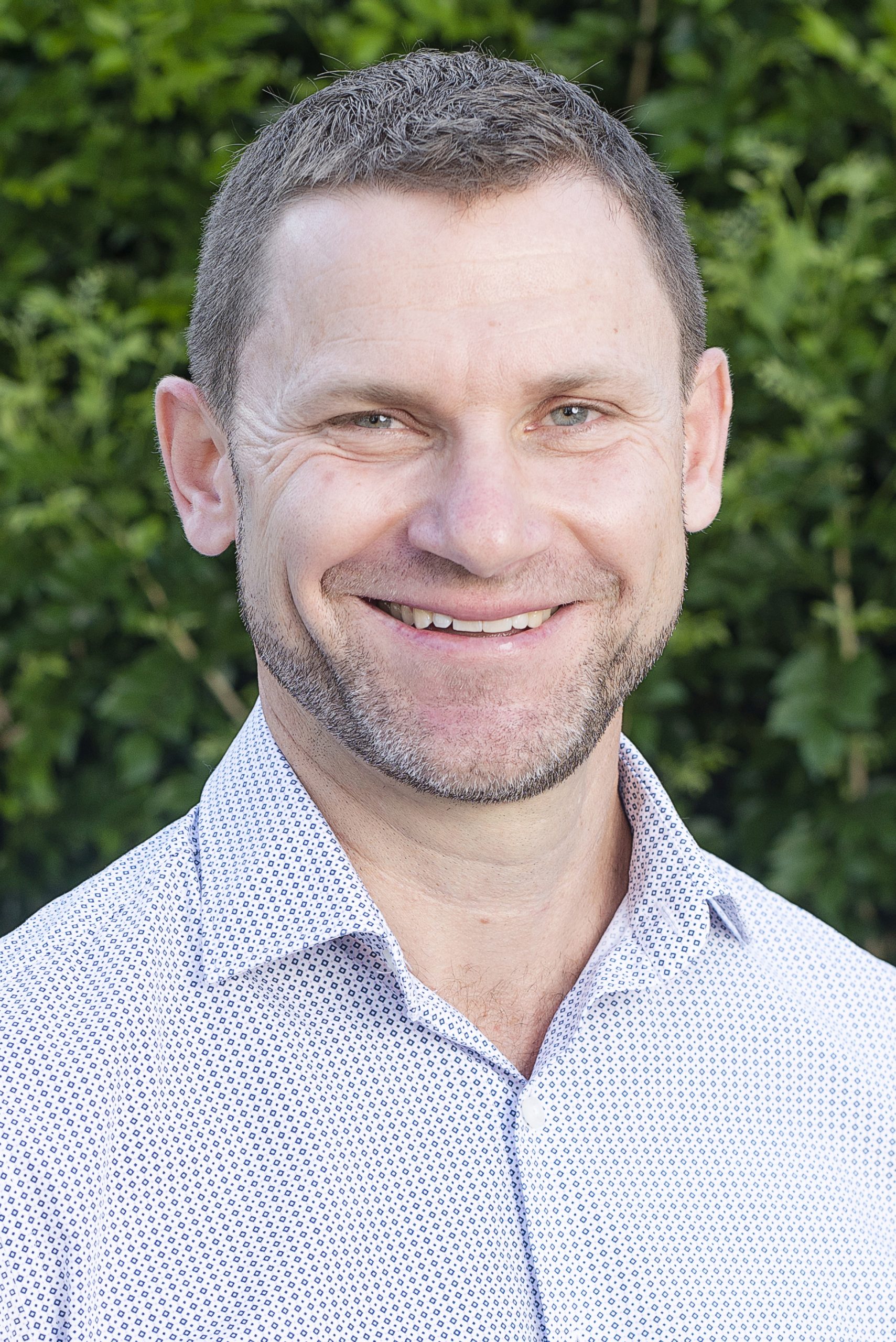
Scott Cook, a highly respected physiotherapist and co-founder of The Headache, Neck & Jaw Clinic, specialises in treating headache, neck, and jaw conditions. Scott refined his expertise through extensive training, including advanced certification with the Watson Headache® Institute and a mini residency in TMD and sleep medicine.
He collaborates closely with dental and medical specialists and lectures at prestigious institutions like the University of Queensland and Griffith University. Scott’s dedication is evidenced through his academic contributions, including authoring a chapter on pain referral in a clinical manual on dental and orofacial pain. You can read more about my background, here.